Important
Provisions of the Bill:
 Ø The Bill proposes food grain entitlements for up to 75
percent of the rural and up to 50 percent of the urban population. Of these, at least 46 percent of the rural
and 28 percent of the urban population will be designated as priority
households. The rest will be designated
as general households.
Ø The Bill proposes food grain entitlements for up to 75
percent of the rural and up to 50 percent of the urban population. Of these, at least 46 percent of the rural
and 28 percent of the urban population will be designated as priority
households. The rest will be designated
as general households.
Ø Priority households will be entitled to 7 kg of
subsidized food grains per person per month.
General households will be entitled to at least 3 kg.
Ø The central government will determine the percentage of
people in each state that will belong to the priority and general groups. State governments will identify households
that belong to these groups.
Ø The Bill proposes meal entitlements to specific groups. These include: pregnant women and lactating
mothers, children between the ages of six months and 14 years, malnourished
children, disaster affected persons, and destitute, homeless and starving
persons.
Ø Grievance redressal mechanisms will be set up at the
district, state, and central levels of government.
Challenges
for the Food Security Bill:
 Ø The Bill proposes reforms to the Targeted Public
Distribution System.
Ø The Bill proposes reforms to the Targeted Public
Distribution System.
Ø The Bill classifies beneficiaries into three groups.
The process of identifying beneficiaries and placing them into these groups may
lead to large inclusion and exclusion errors.
Ø Several entitlements and the grievance redressal
structure would require state legislatures to make adequate budgetary
allocations. Implementation of the Bill
may be affected if states do not pass requisite allocations in their budgets or
do not possess adequate funds.
Ø The Bill does not provide a rationale for the cut-off
numbers prescribed for entitlements to priority and general households.
Ø The grievance redressal framework may overlap with that
provided in the Citizens’ Charter Bill that is pending in Parliament.
Ø Schedule III of the Bill specifies goals which may not
be directly related to food security. It
is unclear why these have been included in the Bill.
Ø The Bill provides similar definitions for starving and
destitute persons. However, entitlements
to the two groups differ.
What
is the Need of such a bill?
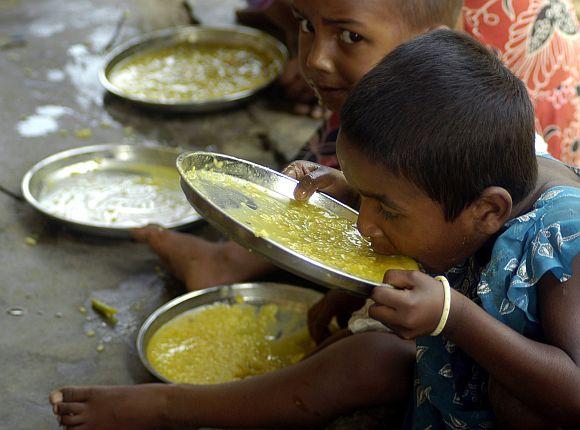
Ø there is more than 8 crore tons of cereals in the FCI
godowns which will increase to become 10 crore ton after the Kharif crops are
harvested and procured. On the other hand, there are children, adults and aged
people who are hungry and malnourished.
Ø Activists of an organisation working for food security,
Rozi Roti Adhikar Abhiyan appealed the government to provide subsidised cereals
for all and asked for an effective National Food security legislation.
Ø Demanded from the government to remove the distinction
of APL-BPL and open the doors of the godowns to distribute the grains to needy.
INCLUSIVE
PDS
Ø Tamil Nadu has gone all the way to a universal PDS,
every household there is entitled to 20 kg of rice every month, that too free
of cost.
Ø Other States that have made significant moves towards a
universal or near-universal PDS (at least in rural areas) include Andhra
Pradesh, Chhattisgarh, Himachal Pradesh, Kerala, Orissa, and Rajasthan.
IMPACT
ON POVERTY:
Ø Based on these implicit subsidy calculations, it is
possible to estimate the impact of PDS on rural poverty — by adding the
implicit subsidy to the explicit NSS estimate of Monthly Per Capita Expenditure
(MPCE) for each sample household.
Ø Using NSS data for 2009-10, it turns out that the PDS
(more precisely, the foodgrain component of the PDS) reduces the Tendulkar
poverty gap by around 18 per cent at the national level. This is a moderate
achievement, but what is more interesting than the national average is the
contrast between States.
Ø In Tamil Nadu, the PDS reduces the Tendulkar poverty
gap by more than 50 per cent. Other States where the PDS has a large impact on
rural poverty include Chhattisgarh and Andhra Pradesh (about 40 per cent), and
also Himachal Pradesh and Kerala (around 35 per cent).